The Matching Furniture Myth: Why a Room Need Not Come as a Set
Matching furniture need not come as a set: learn how repeated shapes, finishes and proportions make a room feel coherent without identical pieces.
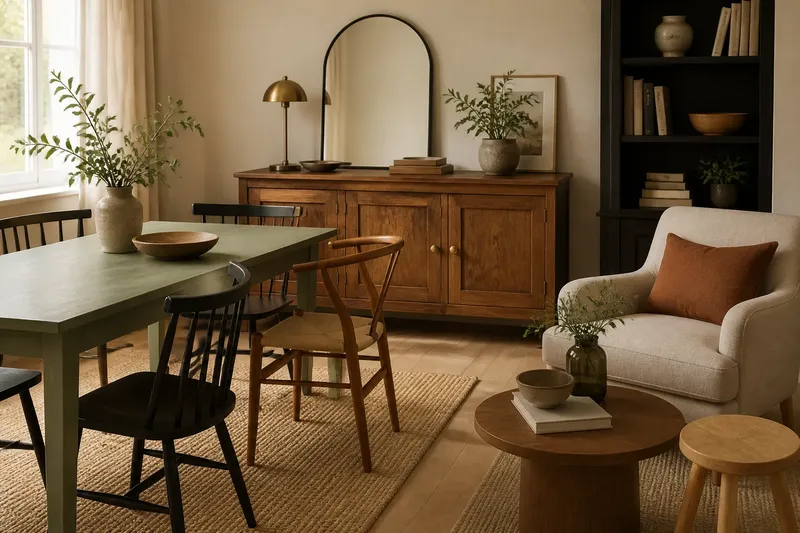
The oak sideboard beside the painted dining table is a little darker, and its handles are brass rather than black. Yet the room feels settled because both pieces have sturdy, simple lines and leave space around their legs. Matching furniture can make a room coherent, but it is only one route to that effect. A few deliberate connections can do the work without turning every chair, table and cabinet into a near-copy.
Matching furniture is one kind of order, not the only kind
A furniture set offers ready-made agreement. The pieces may share a finish, profile and hardware, so the eye recognises them as related. That can be useful when furnishing a room from scratch, especially if choosing separate pieces feels daunting. But sameness can also flatten a room: each object repeats the same visual note, and the space has little to reveal on a second look.
A collected room works differently. It allows individual pieces to keep their own character while giving the eye a few points of recognition. A rounded chair back might echo the curve of a mirror; a pale timber stool might pick up the tone of a cabinet interior. These links do not need to be exact. Their purpose is to make the differences feel considered rather than accidental.
It helps to distinguish matching from coordination. Matching repeats the same object or finish. Coordination lets related qualities recur: shape, material, colour, scale or visual weight. A room can use one of these connections strongly and leave the others varied. It does not need to coordinate everything at once.
Choose a repeated quality before choosing another piece
Look at the furniture already in the room and identify what feels most distinctive. It might be the tapered legs of a dining table, the dark stained wood of a bookcase, or the broad, low silhouette of a sofa. Treat that quality as a thread, not a rule. Another piece can pick it up in a different way.
Shape is often the easiest thread to use because it remains visible even when colours differ. A circular coffee table can sit comfortably with a sofa whose arms are softly curved, while a straight-sided bookcase keeps the arrangement from becoming too soft. Repetition need not mean repeating a whole outline. It can be as small as a rounded corner, a narrow rail or a slight taper at the foot.
Finish offers another connection. A walnut cabinet and a lighter oak table are not the same, but both may have a quiet, natural surface rather than a glossy one. A blackened metal lamp base can relate to dark cabinet pulls without matching their exact sheen. When using wood, compare the undertones and surface character as well as the names of the species: two pieces called oak can still look markedly different.
Let proportion carry the connection
Furniture can belong together through scale even when its materials differ. A broad dining table needs chairs with enough visual presence to meet it; delicate spindles may feel lost beside a heavy top. Conversely, an ornate, substantial chair can overwhelm a small, fine-legged table. Compare the apparent weight, not just the overall size.
Height matters in the same quiet way. A low cabinet beside a tall bookcase can make a useful change in outline, while a procession of pieces with nearly identical tops may look like one long block. Repeated heights can still work, but a shift in width, leg shape or finish gives the eye a reason to distinguish one object from the next.
Imagine you have inherited a narrow pine dining table and are choosing chairs. Rather than searching for the same pine, you could consider simple painted chairs with a back rail that echoes the table’s straight apron. If their frames feel light enough for the table and the paint sits comfortably beside its warm timber, the difference reads as intentional. The useful check is to place one chair beside the table and look at their outlines and tones together before committing to a full group.
Keep contrast deliberate and limited
Contrast gives a room character, but every difference asks for attention. If a room already combines pale timber, dark metal and upholstered seating, adding a strongly patterned cabinet and an unrelated high-gloss table may create more competition than interest. A restrained contrast is easier to read: keep one quality close and let another depart.
For instance, two side tables might have different shapes but a similar timber tone. Or a pair of chairs might share a frame colour while using different upholstery textures. The familiar quality gives the eye a foothold; the variation prevents the arrangement from feeling prescribed. This is especially useful when separate pieces have arrived at different times or from different rooms.
Not every object needs a companion. A distinctive antique chair or sculptural console may be stronger when left alone, rather than surrounded by forced echoes. It is not worth buying small decorative objects simply to repeat a furniture finish. If a connection is hard to notice without explanation, it may not be doing useful work.
Check the room as a whole before deciding
Individual pieces can look convincing in a shop and awkward once placed among existing furniture. Consider the view from the doorway and the way the room is used: a table should still offer comfortable seating, and a cabinet should not feel visually crowded by a nearby chair. The aim here is not to rearrange the room, but to see whether the pieces share enough character to sit together.
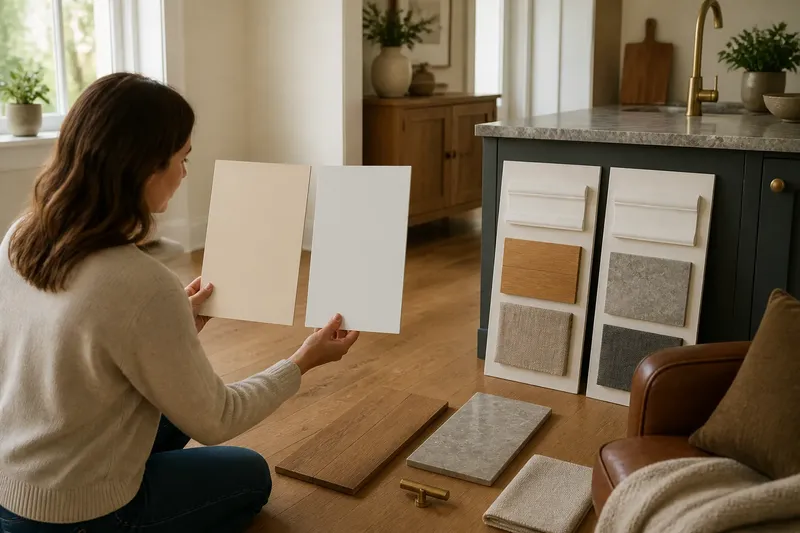
A simple comparison can help. Bring finish samples or photographs into the room, then look at them beside the furniture in daylight and under the room’s usual lamps. A finish that seemed close in a shop may reveal a cooler or redder cast at home. If the relationship still feels convincing in both conditions, it is less likely to depend on one flattering moment.
Material labels and care requirements matter when choosing a finish or combining surfaces, so check the maker’s guidance where it applies. Beyond that, trust what is visible: whether the grain feels too busy beside another pattern, whether a shiny surface calls more attention than intended, and whether the pieces appear balanced from ordinary seating positions.
Which details make mismatched furniture feel connected?
Can different wood finishes work in the same room?
Yes. Look for a relationship in undertone, texture or level of sheen rather than demanding identical wood. A warm, matte timber can sit well beside a deeper one if the room contains a calm bridge, such as a neutral rug or a painted piece.
Do all dining chairs need to match?
No, but a shared feature helps the group read as one arrangement. Similar seat heights, a common frame colour or repeated back shapes can connect chairs with different details. Keep their proportions suitable for the table and the people using it.
How many finishes can a room combine?
There is no fixed count that suits every room. The more distinct finishes you introduce, the more each needs a reason to be there, such as a repeated shape or a calm relationship in tone. If the eye keeps jumping between unrelated surfaces, simplify one of the contrasts.
What if the pieces feel unrelated after they arrive?
Try a reversible adjustment before replacing furniture. A cushion, table runner or small change of position may help a shared quality become visible, provided it also suits the room’s use. If the pieces still compete, it may be better to keep one as an accent elsewhere.
Allow the room to become coherent over time
There is no need to buy every piece at once to make a room feel finished. A measured pause can show which quality is missing: perhaps the room needs another warm timber note, or a lighter silhouette beside a dense cabinet. Waiting for that need to become clear is often more useful than buying a matching set simply to close the decision.
The matching furniture myth persists because sets offer certainty, but certainty is not the same as cohesion. A room can hold different periods, finishes and forms while still feeling composed. Repeat one or two qualities with care, let the rest remain distinct, and judge the result in the room rather than by whether every piece began in the same catalogue.