Before the Lampshade: A Short History of the Reading Lamp
The history of the reading lamp is also a history of where people read. See how table, chair-side and bedside lighting answer different domestic needs.
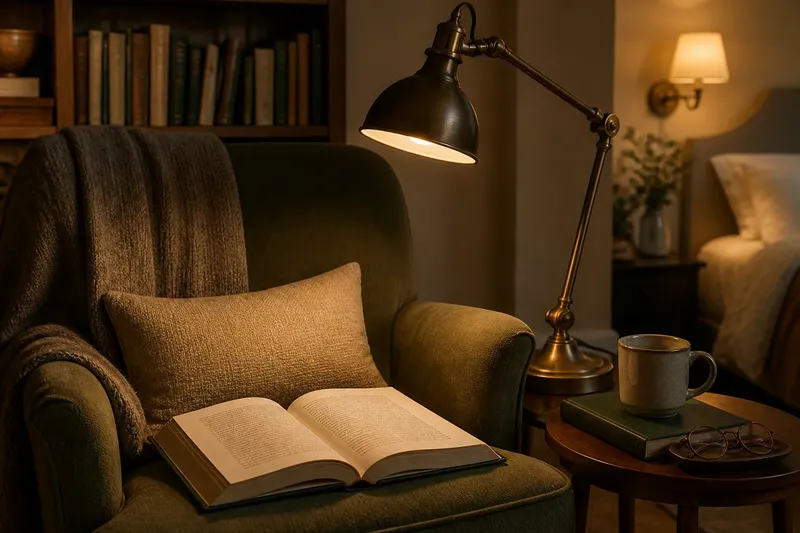
A book lies open on an armchair, but the ceiling light leaves the lower half of the page in shade. The history of the reading lamp begins with this small mismatch between a reader’s position and a room’s general light. Its forms make most sense when we look at the places they serve: a shared table, a favourite chair, or the edge of a bed.
Shared light kept reading close to the table
Before electric lamps became familiar in homes, domestic light came from sources such as candles and oil lamps. Their placement mattered. A flame needed a stable surface and careful attention, so people tended to bring their work or reading to the light rather than expect it to follow them around the room.
That arrangement did not make every reading session a solitary one. A book could be read aloud at a table, while someone else sewed or listened. The lamp served the household’s activity, not a particular reader’s posture. Its practical job was to make a shared patch of space usable.
This is a more useful starting point than a story in which one particular lamp suddenly becomes the reading lamp. The distinction emerged gradually in use. When a reader wanted light at a chair or bedside, placement and control mattered as much as the shape of the fitting.
Chair-side lamps gave reading a settled place
A chair-side lamp made it possible to keep a reading place ready without changing the light for the whole room. A side table could hold the lamp and a book. A floor lamp could stand nearby when table space was scarce. Neither arrangement needed to turn the chair into a separate room; it simply brought useful light closer to the reader.
Design details followed the task. A shade could screen the bright source from a seated reader’s eyes. A swivel or adjustable arm could redirect light when the book moved, although it added joints and controls to operate. A fixed shade could be a calmer choice if the chair and lamp stayed in one position.
The pairing also changed how a room read visually. An armchair beside a lamp and a small table suggested a place to pause, even when no one was sitting there. The lamp’s role came from its position and use, not from a special label attached to its base.
Bedside lamps followed a different posture
Reading in bed asks different things of a lamp. The reader may be lying back, holding a book higher than they would in a chair, and reaching for the switch without standing up. A compact base or a wall-mounted fitting can leave more room for a book, glasses or water on the bedside surface.
Here, reach is part of the design. The switch needs to be accessible from the bed, and the light should reach the page without shining directly into someone’s eyes. Bedding and pillows can block a beam or crowd a lamp, so the position that works beside a chair may feel awkward at the bedside.
Chair-side and bedside lamps belong to the same family, but they answer different habits. One is arranged around a seated body and often a nearby table; the other must work from a reclined position with controls close at hand.
Why do reading lamps need different positions?
Why can a bright ceiling light leave a page hard to read?
General room light reaches walls and furniture as well as the book, and it may not fall directly on the page. A nearby lamp can put light closer to the reading task, while a shade helps keep the source out of the reader’s direct line of sight.
Should a reading lamp stand beside or behind a chair?
Either position can work if the light reaches the open page without crossing the reader’s face or casting a strong hand shadow. Sit in the chair with a book open and adjust the lamp from there, rather than judging its position while standing across the room.
What makes a bedside reading lamp different?
Its control and light need to suit someone lying down, and its base or fitting must leave room for bedside essentials. A lamp that works well beside an upright chair may be too far away or awkward to switch off from bed.
Is an adjustable arm useful for reading?
It helps when the book or task moves, but it is not essential if a fixed shade reaches the page from the lamp’s usual position. Consider how often the light needs redirecting, and whether the arm will be easy to move without disturbing nearby objects.
Choose the lamp by checking the reading position
A few direct checks make the choice clearer. Sit or lie where the lamp will be used, open a book, and notice what happens to the light as you hold the page. Then follow each observation to a practical decision:
- If the bulb is visible from the reading position, choose a shade or angle that screens it; if it remains out of sight, keep the simpler fitting.
- If your hand casts a shadow across the page, move the lamp to the opposite side or adjust its arm; if the page stays clear, keep the current position.
- If the light falls on the wall rather than the book, direct the shade towards the page; if it reaches both comfortably, avoid unnecessary repositioning.
- If the lamp crowds the book or other items on the table, use a floor lamp or wall fitting instead; if the surface remains usable, a table lamp can stay.
- If you cannot reach the switch from bed, choose a more accessible control or fitting; if you can operate it without stretching, its location is workable.
- If the lamp wobbles when you adjust it, choose a steadier base or a fixed shade; if it remains stable, an adjustable arm may suit the routine.
Say a reader moves a chair beside a bookcase and finds that the existing table lamp lights the wall, not the novel. They sit down with the book open, notice that the lamp’s shade points away from the page, and turn it towards the chair. The page becomes easier to see, but the bulb is now visible from the seat. They move the lamp to the other side of the chair and angle it down; the page is lit without the bulb entering their line of sight. The trade-off is a narrower gap for the side table, so they keep only the book and a cup there. That result gives them a clear choice: retain the table lamp in its new position if the reduced surface is acceptable, or use a floor lamp if the table needs to stay clear.
Materials shape the lamp’s presence as well as its light
A heavy base can feel settled on a small table, while a slim stem takes up less visual space near a chair. A fabric shade softens the appearance of the source; a metal shade makes its direction more explicit. These are not steps in a fixed history. They are choices about how a lamp sits in a particular room and how its light meets a page.
It is not worth choosing an elaborate articulated arm simply because it looks purpose-built. If it is awkward to adjust or occupies the surface needed for a book, a stable lamp with a well-placed shade may serve the routine better. Equally, a plain fitting cannot compensate for a switch that is hard to reach or light that misses the page.
The reading lamp remains part of the room’s arrangement
A lamp beside a chair or bed marks a familiar place even when it is switched off. Its position relates to the book, the seat, the table and the route a person takes through the room. The most convincing arrangement tends to make those relationships feel easy rather than carefully staged.
For the history of the reading lamp, the useful question is not which style came first, but how the object followed a reader’s posture. Shared light gathered people around a table; a chair-side lamp brought light to a settled seat; a bedside fitting made reading possible without leaving the bed. Before choosing a new one, notice where the book is held and where the switch can be reached. That small observation often points to the right kind of lamp before its finish or shape does.